
Introduction
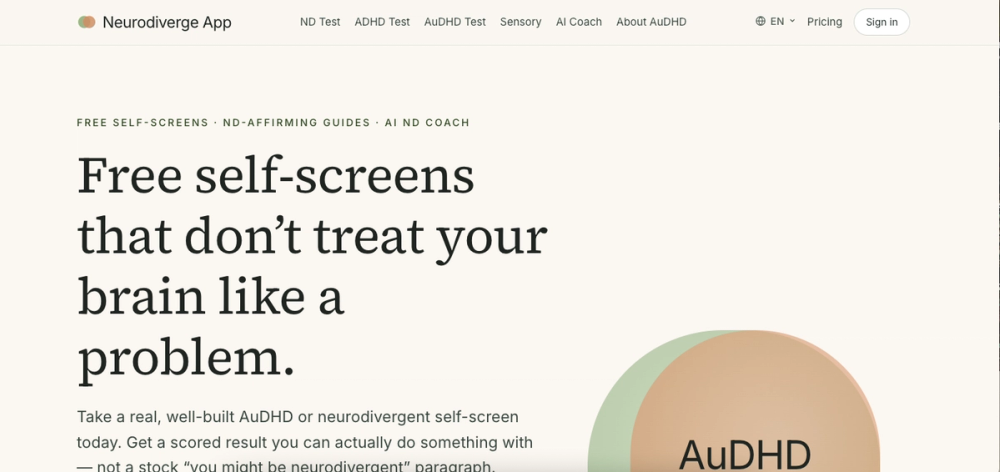
Neurodiverge App is a self-screening and educational platform for adults exploring whether they might be autistic, ADHD, AuDHD, or otherwise neurodivergent. Unlike the single-page am I autistic quizzes that end on a vague paragraph, the public site presents a set of multi-dimensional self-screens built from validated instruments, translated into plain English, and scored with result pages designed to offer next steps including guidance on finding a neuroaffirming clinician. It appears most relevant for adults who have recently recognized neurodivergent traits in themselves whether through a child's diagnosis, a burnout episode, a therapist's observation, or simply reading someone else's account that felt too precise to dismiss. The site is identity-first and neuroaffirming: it does not use deficit framing, does not recommend Applied Behavior Analysis, and keeps its core self-screens free. Readers should remember that these are self-screens not clinical diagnoses.
Key Features
- Four free self-screens covering neurodivergent traits, AuDHD overlap, adult ADHD, and sensory profiles
- Neurodivergent Test: 30 questions across six dimensions - autism, ADHD, dyspraxia, dyslexia, sensory processing, and tics - with a six-dimension scored profile
- AuDHD Test: 20 questions covering the overlap of autism and ADHD - hyperfocus, masking, sensory load, and executive load - designed to capture how the two conditions interact rather than treating them in isolation
- Adult ADHD Test: 20 ASRS-informed questions across four dimensions - inattention, hyperactivity, executive function, and emotional regulation - with subtype lean and per-dimension breakdown
- Sensory Profile Test: 24 questions across all eight sensory channels - hearing, sight, touch, smell, taste, balance, body, and interior - with a radar-chart result and per-channel accommodation suggestions
- Result pages that explain what your score does and doesn't mean rather than ending on a generic paragraph
- ND-affirming guides including a long-form AuDHD explainer grounded in lived experience and current peer-reviewed literature
- Pro features including a daily tracker and an AI ND coach
Use Cases
Neurodiverge App is built for adults who suspect they might be neurodivergent but aren't sure where to start. If you have spent years being told you are too intense or not trying hard enough, and neither anxiety nor depression fully explains your experience, the public site suggests this platform offers a structured way to explore that question without rushing toward a label.
It also appears useful for people who are already identified as autistic or ADHD and want to understand the overlap. The AuDHD explainer pages describe how the two conditions interact - for example how autistic monotropism can create deep focus while ADHD executive dysfunction makes starting non-preferred tasks nearly impossible - and offer practical guidance on masking, burnout, and late diagnosis. If you are a parent who recognized yourself in your child's neurodevelopmental assessment, the recognition-moments section may feel particularly relevant: the site reports that a child's diagnosis is the single most common trigger for adult recognition accounting for roughly 35% of cases.
Pricing
Neurodiverge App keeps its core self-screens free, and the public site explicitly states this will not change. The site frames this as a commitment rather than a promotional offer.
- Free tier: All four self-screens with scored results plus ND-affirming guides
- Pro: $49/year - includes a daily tracker and an AI ND coach
The Pro plan appears designed for people who want ongoing support beyond a one-time self-screen. Readers should check the current pricing page for any changes to what the Pro tier includes since the evidence does not detail additional features beyond the tracker and AI coach.
User Experience and Support
The self-screens are designed to take 4 to 6 minutes with the option to skip any question. No signup is required to start, and the interface emphasizes plain English rather than clinical language. The result pages aim to tell you what your score actually means for your daily life, what kind of professional to talk to, and how to find a neuroaffirming clinician.
Support details beyond the self-screen and guide content are not clearly visible on the public pages. There is no evidence of a dedicated help desk, live chat, or community forum. If you need help with your account readers should look for a contact link in the site navigation.
Technical Details
Neurodiverge App is a web-based platform that uses validated clinical instruments as the foundation for its self-screens. The public site mentions the RAADS-14 short-form for autism traits, ASRS-style items for ADHD, and Dunn-inspired buckets for the sensory profile. These instruments are translated into plain English and scored locally with results presented in a way that avoids both clinical coldness and vague reassurance.
The platform appears to be accessible through a standard web browser with no app download required. The site does not mention offline access, mobile apps, or API integrations.
Pros and Cons
Pros:
- Free self-screens that don't require signup, email, or payment to access
- Built from validated instruments rather than recycled generic quiz questions
- Result pages offer practical next steps not just a score or paragraph
- Explicitly neuroaffirming with no deficit framing, no ABA recommendations, no functioning labels
- AuDHD-focused content addresses a gap that many general neurodivergence resources miss
- Pro tier is affordable at $49/year and includes daily tracking
Cons:
- Self-screens are not clinical diagnoses and should not be treated as one
- Support and contact options are not clearly visible on the public pages
- The Pro plan full feature set is not detailed beyond the tracker and AI coach
- No mobile app or offline access is mentioned on the public site
- The platform currently appears English-only which may limit accessibility for non-English speakers
FAQ
Is the Neurodiverge App a diagnostic tool?
No. The public site is explicit: these are self-screens not clinical diagnoses. The result pages explain what your score does and doesn't mean and they include guidance on what kind of professional to talk to if you want to pursue a formal assessment.
What makes these self-screens different from the Am I Autistic quizzes on Google?
The public site describes the common quizzes as recycling the same 10 questions, scoring against a hidden cutoff, and ending on a vague paragraph. Neurodiverge App instead uses validated instruments, translates them into plain English, and provides result pages that explain the score in practical terms including next steps and clinician-finding guidance.
Can I take the self-screens without creating an account?
Yes. The public site states: No signup to start. No diagnosis. No medical advice. 4 to 6 minutes. Skip any question. You can take any of the four self-screens without providing an email or creating an account.
What does the Pro plan include and is it worth it?
The Pro plan costs $49/year and adds a daily tracker and an AI ND coach. Whether it is worth it depends on whether you want ongoing support beyond a one-time self-screen. The public site does not detail additional Pro features beyond these two so readers should check the pricing page for current details before subscribing.
Is this platform safe for people who are exploring neurodivergence for the first time?
The public site takes a deliberately non-clinical non-pathologizing approach. It does not use deficit framing, does not recommend ABA, and does not gate safety-critical content behind a paywall. The self-screens are designed to be exploratory rather than prescriptive and the result pages explain the limitations of a self-screen alongside what the score suggests.
How does the AuDHD content differ from general autism or ADHD resources?
The AuDHD pages describe how autism and ADHD interact - for example how each side partially masks the other on standard screening items making it easy to score in the maybe middle on either condition individually. The content also covers the historical DSM rule that prevented dual diagnosis until 2013 which the site identifies as a major reason many adults are only now discovering the overlap.
Conclusion
Neurodiverge App offers a thoughtful alternative to the generic neurodivergence quizzes that dominate search results. Its self-screens are grounded in validated instruments, its result pages aim to be genuinely useful, and its AuDHD content fills a gap that many broader resources overlook. If you are an adult exploring whether you might be autistic, ADHD, or both, the free self-screens on neurodiverge.app provide a low-barrier starting point. For ongoing support the Pro tier daily tracker and AI coach may be worth exploring at $49 per year but check the current feature details before committing.