

Introduction
Rate My Professors is a student-powered professor ratings and course review platform that helps students compare teaching styles before choosing classes. The public site presents Rate My Professors as a place to read anonymous feedback from real students, rate professors, search professors, browse countries, visit forums, and suggest a university.
The clearest audience is students who want practical context before enrollment, especially when course selection depends on teaching style, difficulty, support, and classroom experience. The site gives a strong overview of its rating mission and review form, while readers should still use individual reviews as guidance rather than as a complete picture of any professor or course.
Key Features
- Professor ratings: Students can rate professors using an overall star rating and optional detailed categories.
- Course review context: The review form includes course-related input, including courses taken and a recommendation field.
- Teaching-style comparison: The platform says it helps students compare teaching styles and choose professors who match the way they learn.
- Anonymous student feedback: The site emphasizes anonymous feedback and asks users to keep reviews respectful and constructive.
- Professor search and country browsing: Visible navigation includes search professors, browse countries, countries, and supported-country sections.
- University suggestion option: The page includes "Suggest University," which appears intended to help expand available school coverage.
Use Cases
Rate My Professors is most useful before course registration, when students are trying to understand how a professor teaches, supports, and engages in class. The public copy focuses on helping students choose better classes by reading honest ratings from real students rather than relying only on course descriptions.
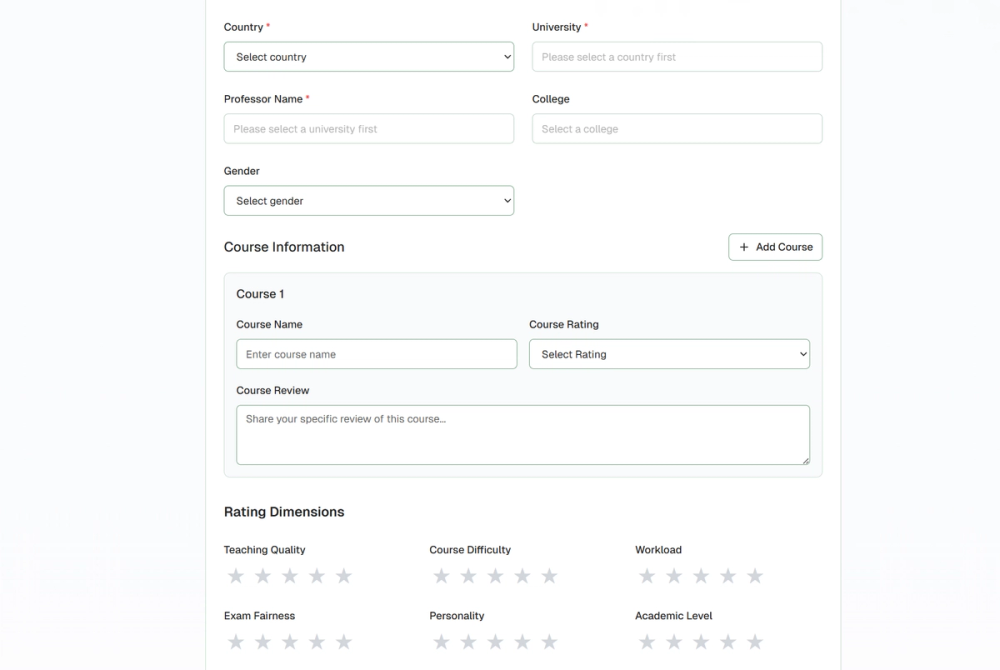
The platform also gives students a way to contribute feedback after taking a class. The review form includes country, university, professor name, department, professor gender, overall rating, teaching quality, course difficulty, personality, respect for students, subject knowledge, research guidance, courses, recommendation, and written comments. That level of structure suggests the site is trying to collect more than a single score.
For universities and academic communities, the site frames student reviews as a source of broader transparency. Its public copy says small ratings can highlight great teaching, surface issues early, and guide more student-centered decisions. Readers should treat that as the platform's stated mission, not as independent proof of institutional outcomes.
Pricing
No pricing or paid-plan details are clearly visible in the fetched page evidence. The site appears to let users read ratings and submit reviews without showing a subscription requirement on the homepage, and the review form states "No account required." Students or institutions looking for premium features, advertising, data access, or administrative tools should verify directly through the site's current terms or contact routes because those details are not shown in the available evidence.
User Experience and Support
The public page is organized around a straightforward student workflow: discover professors, search professors, rate a professor, browse supported countries, visit forums, and suggest a university. The rating form includes prompts that encourage respectful comments and warn users not to share personal information, which is important for a community review platform.
Support-style signals are visible through navigation and platform links rather than a detailed help center. The site shows Terms of Service, Privacy Policy, About Us, Forum, Suggest University, and "Learn how it works." It also states that reviews are stored securely, though readers should review the privacy policy and terms to understand moderation, data handling, review removal, and account or no-account behavior.
Technical Details
Rate My Professors is presented as a web-based platform for student reviews. The fetched evidence shows a form-driven review flow with country and university selection, professor details, rating categories, optional courses, written comments, self-verification, and a verification code.
The page says reviews are stored securely and no account is required. It also includes platform links for Terms of Service and Privacy Policy. The evidence does not show an API, mobile app, integrations, moderation tooling, or data export options, so those should not be assumed.
Pros and Cons
Pros
- Focused on a practical student decision: choosing professors and courses with more context.
- Uses structured review fields rather than only a general comment box.
- Encourages anonymous, respectful, and constructive feedback.
- Includes search, country browsing, forums, and university suggestion signals.
- The review flow says no account is required, which may reduce friction for students who want to contribute.
Cons
- Review quality depends on student participation, balance, and moderation, which readers should keep in mind when interpreting ratings.
- The fetched page includes a placeholder-style "Lorem ipsum" line, suggesting at least one section may still need editorial cleanup.
- Pricing, premium features, and institutional options are not clearly visible.
- The available evidence does not explain moderation rules, dispute handling, or review verification depth beyond a self-verification prompt.
FAQ
What is Rate My Professors used for?
Rate My Professors is used to read and share professor ratings and course reviews. The site says students can read honest ratings, compare teaching styles, and choose professors who fit the way they learn.
Who is Rate My Professors best suited for?
It is best suited for students who are choosing classes, comparing professors, or trying to understand likely classroom experience before enrolling. It may also be useful for students who want to leave feedback that helps others make course decisions.
What can students rate on the platform?
The visible review form includes an overall rating plus detailed fields such as teaching quality, course difficulty, personality, respect for students, subject knowledge, research guidance, courses, recommendation, and written comments.
Does Rate My Professors require an account to submit a review?
The public page says "No account required" near the review submission area. Students should still review the site's current terms and privacy policy to understand how submissions, verification, and stored reviews are handled.
Is pricing shown for Rate My Professors?
No pricing or paid-plan information is clearly visible in the fetched evidence. The homepage appears focused on student ratings and review submission rather than paid access, but any premium, institutional, or advertising options would need to be verified separately.
How should students interpret professor ratings?
Students should treat ratings as one input, not as a final judgment. Reviews can help reveal patterns around teaching style, difficulty, and support, but individual comments may be subjective, outdated, or influenced by a specific course experience.
What privacy or conduct details should reviewers check?
The page asks reviewers not to share personal information and to keep feedback respectful and constructive. Before submitting, reviewers should check the Terms of Service and Privacy Policy to understand what information is collected, how reviews are stored, and what moderation rules apply.
Conclusion
Rate My Professors offers a focused way for students to compare professors, share anonymous feedback, and make more informed course decisions. Its strongest visible signals are the student-powered review model, structured rating form, and emphasis on respectful comments.
The platform is most useful when students read reviews carefully, look for recurring patterns, and combine ratings with other academic information. Anyone submitting feedback should keep comments constructive and review the site's terms before posting.